
Your Business May Be Growing Faster Than the Structure Behind It.
Revenue can grow. Customers can grow. Payroll can grow. Equipment can grow. But if the financial infrastructure behind the business never matured with it, growth starts creating pressure where there should be leverage.
A lot of owners assume that if the business is doing real volume, the system behind it must be strong too.
That is not always true.
We see businesses with real traction, real teams, real jobs in motion, and real money coming in — but underneath that progress, the financial foundation is still fragmented. Debt is in the wrong place. Reporting is incomplete. Banking relationships are too small. Capital decisions were reactive. The business is carrying real weight on a structure that was never built for the company it has become.
This usually is not a growth problem. It is an infrastructure problem.
- the bank is asking strange questions
- approvals are slower or smaller than expected
- a truck, line, or loan should be easier than this
- the business is healthy, but the owner still feels financially constrained
- every funding move feels reactive instead of strategic
That is why this problem hides for so long.
The business can still be operationally strong while the systems behind it remain immature, tangled, or incomplete.


Financial infrastructure is not one thing. It is the entire system behind the business.
- how business debt is structured
- whether personal credit is still carrying business weight
- whether the business file is accurate and lender-ready
- whether payment history is building the profile it should
- whether the banking relationship fits the size and direction of the company
- whether the capital stack was built intentionally or reactively
- whether the business is positioned for the next move, not just the current emergency
Here are some of the most common signs the business is ahead of the system behind it.
- the business is doing real revenue, but approvals still feel inconsistent
- the owner is still personally tied to too much of the company
- you are making payments, but not building meaningful business credit
- the current bank feels too small, too slow, or too rigid for where the business is headed
- financing decisions have been made one by one instead of against a real long-term roadmap
- the company looks strong in daily operations but weak in lender-facing systems
- every new move feels harder than it should for a business at your size
The business you are running and the business they are seeing may not be the same thing.
The owner sees:
- Jobs Being Completed
- Invoices Being Paid
- Crews Working
- Equipment Moving
- Customers Coming Back
The lender may be seeing:
- Personal Exposure Where Business Exposure Should Be
- Reporting Gaps Or Weak Business File Depth
- A Banking Relationship That Has Not Matured With The Company
- Debt Structures That Look Reactive
- A Capital Stack That Suggests Pressure Instead Of Control
More revenue does not automatically solve structural weakness.
A lot of owners believe growth will eventually clean all of this up.
Sometimes growth actually makes it worse.
Why?
Because the bigger the business gets, the more expensive structural mistakes become.
What was manageable at $300K can become a real constraint at $1.2M.
What was tolerable at $800K can become a major leverage problem at $2.5M.
- higher-stakes approvals
- larger missed opportunities
- more personal exposure
- worse lending terms
- heavier cleanup later

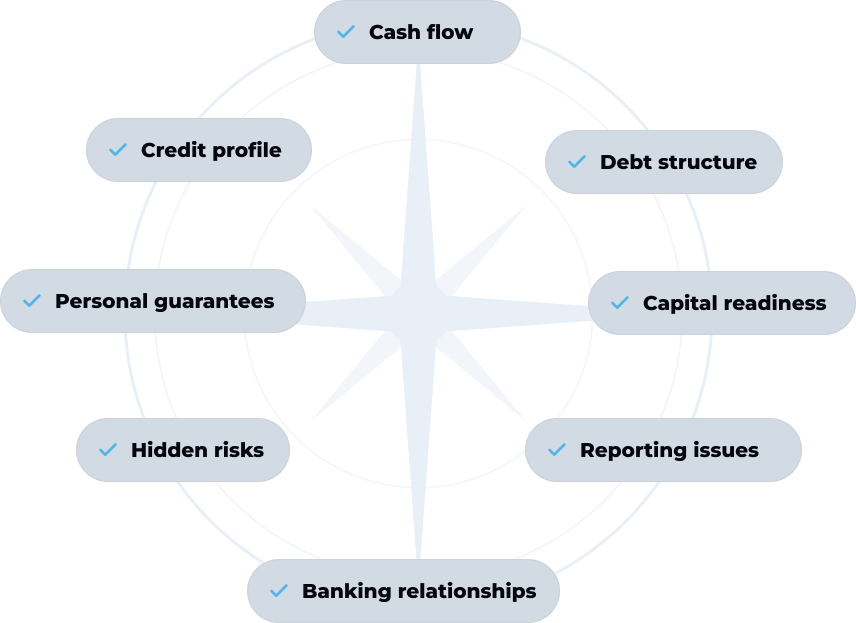
RivenWay starts by reviewing the business the way a banker or underwriter would.
The goal is not to sell a product.
The goal is to understand what is actually true, what is quietly creating drag, and what needs to be corrected before the next move.
That is what the Financial Review is built to do.

The goal is not to sell a product.
The goal is to understand what is actually true, what is quietly creating drag, and what needs to be corrected before the next move.
That is what the Financial Review is built to do.
This is not hypothetical. It is one of the most common patterns RivenWay sees.

revenue

payroll

equipment

customers

payment history

real ambition